


Why little hands find electrical hazards so interesting
Once a baby starts crawling, your home changes shape. Skirting boards become race tracks, plug sockets sit at precisely the height of a curious finger, and a phone charger left dangling from the wall looks very much like a handle. Children under five are fast, determined and completely without a sense of consequence, which means their safety depends far more on the environment around them than on any warning they are not yet able to understand.
The reassuring news is that most electrical risks in a family home can be reduced with a handful of sensible, inexpensive changes. Some of them are things you can do this afternoon; others are worth a conversation with a qualified electrician. Taken together, they create a home where small mistakes are far less likely to become serious ones.
Socket covers: the well-meaning product that often causes more harm
Many parents instinctively reach for plastic socket covers, and it feels like the responsible thing to do. Unfortunately, UK electricians and safety organisations have warned for years that these covers can make things worse rather than better.
British three-pin sockets (to BS 1363) already contain internal shutters. These only open when the longer earth pin is pushed in, which is why a child poking a hairgrip or a toy into a socket will usually meet solid plastic. A socket cover, however, has its own earth pin, and its job is to hold those shutters open for as long as it is in place. If a child prises the cover out – or, as happens surprisingly often, it is pushed back in upside down – the shutters are defeated and live contacts can become reachable.
Safer alternatives include:
- Positioning furniture, a sturdy box or a full bookcase in front of low-level sockets that are not in use.
- Asking an electrician to replace a rarely used socket with a blank plate, so there is nothing to investigate at all.
- Keeping sockets that must stay live – for a lamp or a baby monitor – behind something solid, with the cable routed out of reach.
- Checking regularly that no cover has been left half-inserted, which is arguably the most dangerous state of all.
Residual current devices: the safety net worth investing in
If there is one piece of electrical protection that genuinely saves lives, it is the residual current device, or RCD. It constantly compares the current flowing out along the live conductor with the current returning along the neutral. If even a tiny amount goes missing – around 30 milliamps, roughly the threshold at which a shock becomes dangerous – the RCD cuts the power in a fraction of a second.
Many older properties still have a consumer unit fitted only with miniature circuit breakers, or even rewireable fuses. These protect the wiring, not the people. If your unit has no RCD protection, or just a single RCD covering the whole house, it is worth asking an electrician about an upgrade. Modern boards often use individual RCBOs, which give every circuit its own combined overcurrent and earth leakage protection, so a fault in one room does not plunge the rest of the house into darkness.
For garden tools, mowers and anything used outdoors, a plug-in RCD is a cheap and effective addition. Whatever you have fitted, press the test button every three months or so. It should trip immediately, and it should be replaced if it does not.
Cables, chargers and the pull-along hazard
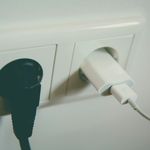
Trailing leads are the quiet troublemakers of family life. A kettle cord hanging over the edge of a worktop can be reached from a high chair, and a phone charger left plugged in at floor level is an invitation to chew. A few habits make a real difference:
- Unplug chargers and small appliances when they are not in use, and store the cable with the device rather than leaving it trailing.
- Keep appliance leads short and pushed to the back of the worktop, and never let a cord hang within a child's reach.
- Use cable tidies, clips or plastic trunking to run leads along skirting boards rather than across the floor.
- Check cables regularly for fraying, kinks, scorch marks or chew damage – and replace rather than repair.
- Avoid running cables under rugs or cushions, where heat can build up unnoticed.
Room-by-room hotspots
- Kitchen: treat the area around the oven, hob and dishwasher as a no-go zone for crawling children. Push appliance plugs fully home, and consider a hob guard if your little one is tall enough to reach the controls.
- Bathroom: electricity and water are a serious combination. Keep portable heaters and hair dryers out altogether, and make sure any socket near a bath or basin is either outside the safe zone or a shaver socket with an isolating transformer.
- Living room and bedrooms: bedside lamps, heated blankets and extension leads are common culprits. Switch off and unplug at the wall overnight, and keep extension sockets out of reach rather than under a bed.
- Garden and outbuildings: use outdoor sockets with spring-loaded or lockable covers, always RCD-protected, and unplug tools when you pause for a cup of tea.
Simple habits, and knowing when to call someone in
Supervision is still the most effective safety measure there is, but it works best when it is backed up by a safe environment. Alongside the steps above, it is worth knowing that an Electrical Installation Condition Report – a thorough check of the fixed wiring – is recommended roughly every ten years for a home you own, and every five for rented property. It is the electrical equivalent of a service, and it will flag anything dated or dangerous before it becomes a problem.
Call an electrician promptly if you notice a socket that feels warm, a plug that sparks when inserted, flickering lights, a burning smell, scorch marks around a switch, or an RCD that keeps tripping. These are not things to live with. With a few sensible precautions and a little professional advice where it counts, you can give your children the freedom to explore their home safely – which is exactly what they are built to do.





John Doe
14 January, 2022Having no content in post should have adverse..
Chauffina Carr
10 April, 2022We use these tests all time! Killer stuff!
Jim Séchen
16 July, 2022Thanks for all the comments, everyone!